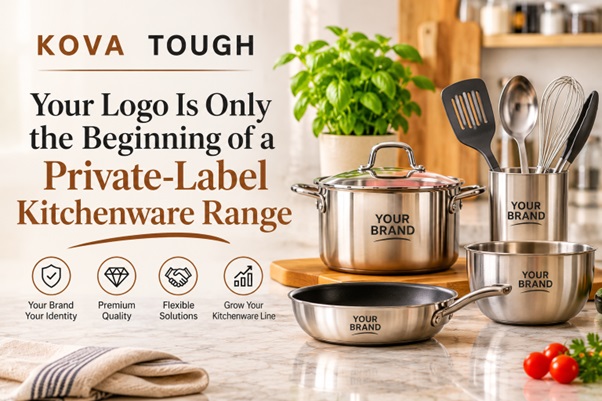
A logo can identify a kitchen tool, but it cannot make an assortment feel considered on its own. Customers notice how the pieces feel, whether they appear to belong together and what happens when they open the packaging.
For a retailer or new brand, private label is an opportunity to make those details work together. The starting point is often an existing product, with branding and presentation developed around the customer and sales channel.
Choose the customer before choosing the catalogue
A kitchenware range for a marketplace seller may prioritise clear product information, protective packaging and a manageable first assortment. A retail gift range may need a more deliberate unboxing experience and space for several pieces to be presented together.
Write down who will use the product, where it will be sold and what the customer expects it to do. Then select tools that have a distinct role. Three useful pieces with clear purposes can be a stronger starting point than a larger set assembled only to increase the count.
KOVA Tough’s private-label kitchenware service brings product selection, branding and packaging into the same discussion. Buyers can start with selected products and define the branded version around their market.
Give every item a clear specification
List each item separately, even when the tools will be sold as a set. Record the requested finish, logo position, pack contents and quantity. A ladle and a turner may share a visual language while needing different dimensions, inspection points and packaging protection.
For example, a proposed set of three tools ordered in 100 complete sets requires 300 individual pieces if each set contains one of each. That is a simple quantity calculation, not a confirmation that a factory will accept the order on those terms. Ask which minimum applies to each product, finish, decoration method and packaging configuration.
KOVA Tough states that minimum orders start from 100 units, with the actual minimum confirmed for the selected configuration. Printed packaging or a custom component may introduce a different requirement, so request the details in the quotation.
Place the logo on the real product
Provide clear artwork and indicate the preferred size and position. The surface may be curved, textured, polished or subject to frequent handling. A mark that looks balanced on a flat drawing may appear too small or lack contrast on the finished tool.
Ask which decoration methods suit the actual material and request a decorated sample. Review the mark in normal use, not just in a close-up image. If the product has multiple components, decide whether each needs a logo or whether a quieter approach gives the range a more coherent appearance.
Treat packaging as part of the product
Define whether the customer receives an individual item, a set, a gift pack or an ecommerce shipment. List all contents, inserts, protective pieces, care instructions and required labels. If the tool has a sharp edge or moving part, discuss suitable protection and how the customer will remove it from the pack.
Ask for a packaging sample with the actual product inside. Check movement, readability and the fit of each component. The outside may look finished while the item shifts in transit or the instructions omit an important care detail.
Keep the retail identity aligned with the contents
The GS1 GTIN management standard states that changing, adding or replacing an item in a predefined assortment requires a new GTIN for that assortment. For a branded utensil set, this makes the contents list a commercial control as well as a design detail. Keep product identifiers, artwork and pack contents aligned when a set changes, and check your retailer’s requirements and the standard for the relevant packaging levels. The rule concerns identification; it does not replace product safety or labelling checks.
Approve the whole configuration
A sensible approval record identifies the product sample, decoration, artwork revision and packaging version. If one changes, review whether the others are still valid. Ask about the documentation needed for the destination market and the particular food-contact materials involved.
KOVA Tough is a new kitchenware brand supported by 20 years of factory experience in Yangjiang. Its published capabilities include production and packing, giving brands an experienced team with whom to review a range from the physical item to the final presentation.
A private-label launch becomes easier to manage when the product, mark and package are treated as one customer experience. The details are easier to change before the order than after the boxes arrive.